
Six weeks. 104 matches. Over six billion people watching.
The World Cup captures the attention of fans across the planet - and with it, an unmatched opportunity for publishers to reach new readers, deepen engagement with existing ones, and turn that attention into lasting revenue.
We followed the tournament closely too - partly out of our love for the game, but also because we wanted to see how publishers approached their live coverage, and how readers actually experienced it.
One match stood out: Germany against Curaçao. We tracked 12 live blogs, run by 9 publishers across 4 countries, as the game unfolded minute by minute. What we found wasn't just that people kept reading - it's when they engaged the most, and it rarely matched the moment you'd expect.
-1.webp?width=800&height=501&name=Hubspot%20Blog%20Images%20(31)-1.webp)
The Goal that Wasn't Germany's
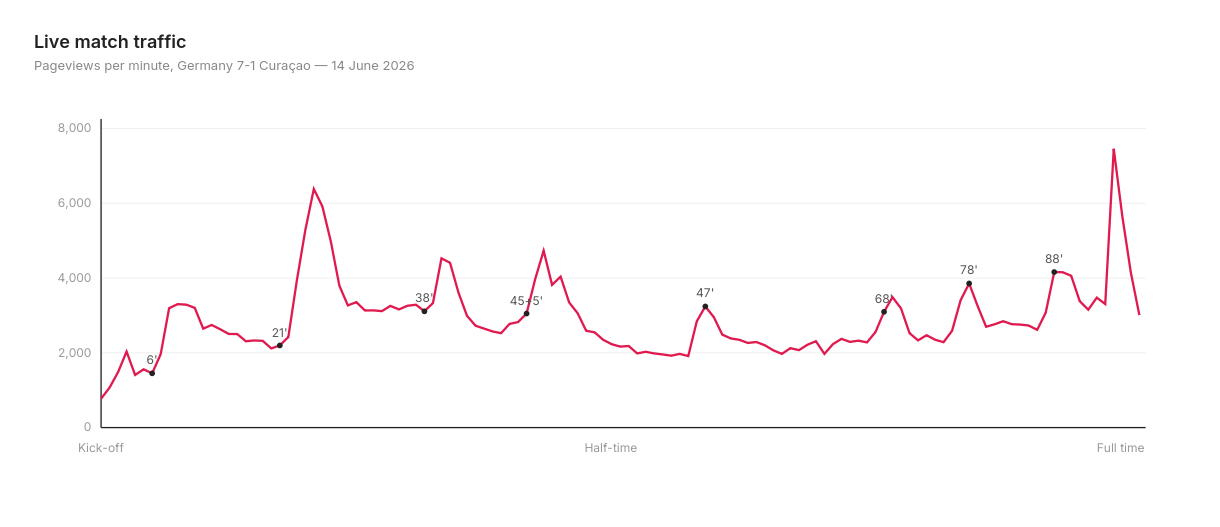
Germany scored seven times. Curaçao scored once. And that one goal - Curaçao's 21st-minute equaliser, the smallest nation ever to qualify for a World Cup finding the net in their tournament opener - produced not only a huge interaction jump but also the biggest pageview jump of any goal in the match. Bigger than any of Germany's seven.
Most live blog readers that day were German. And yet they responded not to the scoreline, but to the significance of the moment - the part no pre-match editorial plan can fully predict.
The takeaway for publishers: build live coverage that can pivot toward the human story, not just the favorite's story. A live blog that's only staffed to cover the expected winner will miss exactly the moment that actually moves an audience.
.png?width=900&height=538&name=Untitled%20design%20(47).png)
By the Numbers: Live Blog Engagement During Germany vs. Curaçao
- 452,421 total pageviews across the match, from just 12 live blogs
- 7,409 reader interactions
- +186% pageview spike after Curaçao's equaliser, bigger than any German goal
- +331% interaction spike on that same goal
- +920% interaction surge after Germany's 7th goal, in the 88th minute, already 7-1
- 7,428 pageviews in the single highest-traffic minute - the final whistle, not a goal
Readers Will React, If You Give Them the Chance
Pageviews tell you people showed up. Interactions tell you they did something once they got there - commented, reacted, voted in a poll. On four of the eight goals, interactions actually grew faster than pageviews did. Curaçao's equaliser is the clearest example: a 331% jump in interactions, against 186% for pageviews. Readers weren't just refreshing the page. They were part of the conversation.
That's worth designing for directly. A poll, a reaction button, or a comment prompt tied to every significant moment - not just the "big" goals - gives readers a way to act on the moment they're already responding to, instead of leaving that energy with nowhere to go.
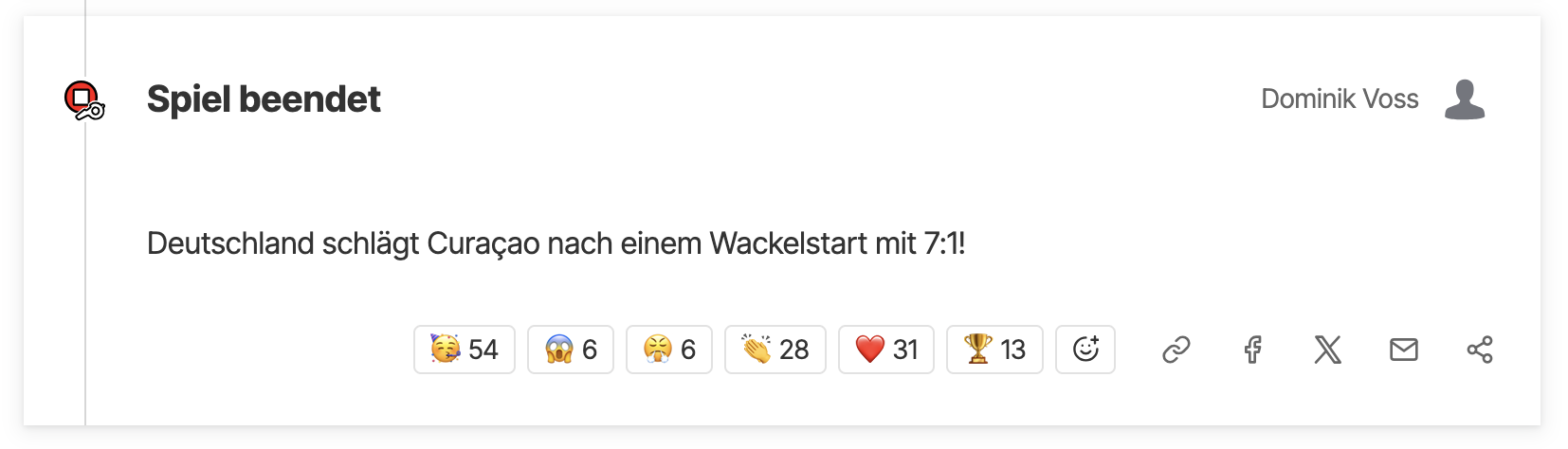
Focus Online live blog post announcing the end of the match.
Engagement Till the Final Whistle
Maybe the most telling number in the whole dataset: the single highest-traffic minute of the match wasn't a goal at all. It was the final whistle - 7,428 pageviews in that one minute, in a game that had been decided for roughly half an hour.
If people were only there for the drama, they'd have left once the outcome was settled. They didn't. Which means the final whistle deserves the same editorial attention as the opening goal - a proper wrap-up, a closing update, a lead-in to what's coming next - rather than a live blog that quietly winds down once the result is no longer in question. The last impression you leave matters: it's what determines whether readers come back next time.
What It Means for Live Blog Monetization
None of this is just an engagement story - it's a monetization one too.
If attention holds through a blowout and peaks at the final whistle, that's revenue a publisher might otherwise write off, treating a decided match as a dead zone. It isn't one. And because interactions spiked independently of pageviews - sometimes growing even faster - they represent a different kind of sellable moment altogether. A sponsored poll or a branded reaction prompt is a more engaging placement than a static banner, and it's a format advertisers will pay a premium for, precisely because readers are already primed to act, not just scroll past.
Live blogs, with their mix of interactive elements and their long-form format, are a natural fit for any publisher looking to expand how they monetize attention - not just how much of it they capture.
What Real-Time Reader Engagement Means for Publishers
None of this is really about one football match. It's about what engagement looks like when you can measure it minute by minute: it doesn't track the scoreline, it doesn't fade once a result feels certain, and it isn't just about how many people show up - it's about what they do once they're there, and how well a publisher is set up to meet them in that moment.
Six billion people were watching this World Cup. The publishers who benefit most won't just be the ones with the biggest audience - they'll be the ones paying close enough attention to catch the moments that actually matter, wherever in the match they happen to land.
Want This Kind of Data on Your Own Coverage?
If a 7-1 blowout can produce numbers like these, imagine what your next big story could reveal. Get in touch, and let's talk about what Tickaroo's Live Blog can do for your audience - and your revenue.