
Journalism shapes democracy - but how does the profession look through the eyes of those just entering it?
In our new Next Gen Journalism Report, we surveyed 172 early-career journalists in the UK to understand how they view the future of journalism, the barriers they face entering the industry, and the skills they believe they’ll need to thrive.
This report offers insights into the next generation of journalists - the people who will shape journalism in the decade ahead.
Here’s a preview of the most important findings.
.webp?width=724&height=453&name=Hubspot%20Blog%20Images%20(25).webp)
A profession with purpose - but in need of reinvention
Most early-career journalists see journalism not just as a job but as a calling - a way to inform, protect, and empower communities.
Yet 69% still believe the industry is in urgent need of reinvention.
Respondents described structural obstacles that make journalism a difficult career to enter and sustain - including low starting wages, outdated hiring practices, and increasing pressure from AI-generated misinformation. Many highlighted barriers to becoming a journalist in the UK, particularly for those without financial support.
Increasingly demanding job descriptions for roles with fewer publications to cut your teeth as a young journalist.
- One of the respondents.
Taken together, these pressures leave many respondents feeling that journalism is a profession in crisis - one that needs meaningful change to fulfil its mission.
Diversity in journalism: essential, yet still out of reach
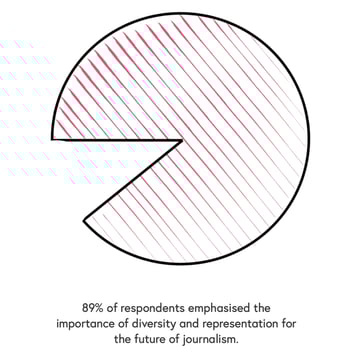
One of the strongest signals from our survey came from the overwhelming majority of respondents (89%) who said diversity and representation are essential for the future of journalism. For early-career journalists, diversity isn’t simply a moral value - it’s fundamental to the future of journalism.
Most participants (69%) noted that a wider range of perspectives leads to more accurate and balanced coverage. When newsrooms reflect the communities they report on, stories become richer, more nuanced, and more grounded in lived experience.
And yet, despite this consensus, many respondents feel that progress in the industry has stalled. They see hiring practices, newsroom culture, and leadership structures that still do not reflect the audiences they serve. For the next generation, the future of journalism depends on who gets to tell the story - and whose stories are allowed to be heard.
The journalism skills gap: ready to write, underprepared for the modern newsroom
Our Next Gen Journalism Report also revealed a troubling skills gap.
With podcasting, long-form storytelling, digital reporting, and investigative journalism
cited as some of the most promising areas in the industry, many entry reporters still don’t feel fully prepared to succeed in these fields.
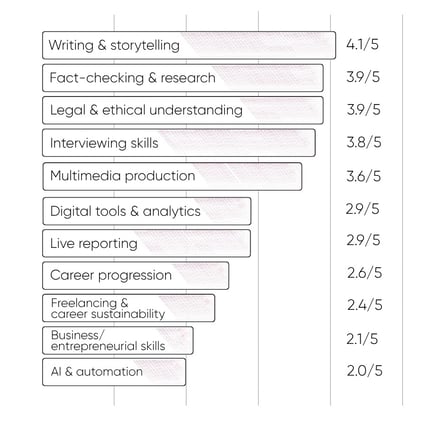 While most respondents feel confident in their foundational abilities - writing, storytelling, and research - their confidence drops sharply when it comes to skills that modern newsrooms increasingly rely on. Live reporting, business and entrepreneurial know-how, and especially AI and automation are areas where they feel noticeably undertrained. In fact, AI and automation received the lowest confidence rating of all, just 2 out of 5.
This reflects a wider trend revealed throughout the Next Gen Journalism Report: journalism education is not keeping pace with the rapid evolution of the industry. Many feel prepared in theory - yet underprepared for data-driven workflows, the technologies shaping modern newsrooms, and other practical, future-oriented skills needed to thrive in today’s newsroom.
Get more insights from our Next Gen Journalism Report
Want to dive deeper into what early-career journalists think about the future of news -including insights on diversity in journalism, the skills gap, barriers to entry, AI-driven ethical concerns, and the overall state of the journalism industry?
Fill out the form below to receive the full report, complete with data, insights, and analysis from our survey of 172 early-career journalists.
Let’s move the industry forward - together.