
.webp?width=1000&height=626&name=What%20Our%20Clients%20Say%20(11).webp)
.webp?width=300&name=New%20Partner%20banner%20(3).webp)
Live reporting is no longer just reserved for major events. From breaking news and elections to...
Read More
Industry events no longer live only in the room. Audiences expect to follow them in real time, wherever they are.
For publishers, that means live coverage has to do more than deliver updates quickly. It needs to create an experience people want to stay with.
The most effective live coverage today combines reporting, commentary, multimedia, and audience interaction in a single space. Rather than simply documenting events, publishers are using live blogs to help audiences - whether on the ground or following from afar - feel part of the action as it unfolds.
Bringing live events to life in real time
The Media Leader’s “Postcards from Cannes” live blog coverage shows what this looks like in practice.
Across both the 2025 and 2026 Cannes Lions festivals, the publication used Tickaroo to transform its coverage into an engaging storytelling experience. With several journalists on the ground and more than 20 contributors, the team used Tickaroo to build a fast-moving, multi-perspective narrative that brought Cannes Lions to life in real time.
Instead of a single reporting stream, the live blogs became a shared editorial space. Reporting, commentary, and audience interaction came together in one live environment.
For audiences, both remote readers and on-site attendees, they acted as a central hub, enabling real-time engagement through reactions, comments, and interactive content throughout the event.
As James Longhurst, Content Director at The Media Leader, put it:
“Tickaroo has meant we can open up the quality conversations that happen on stages and bring them alive on our pages.”
Engagement that reflects attention, not just reach
The results from both editions of the live blog demonstrate the value of an interactive approach.
- 2025: 4+ minutes average engagement time and 284 audience interactions
- 2026: 3.5 minutes average engagement time and 778 audience interactions
The most significant metric wasn't volume - it was attention.
Readers didn't simply drop in for a quick update. They stayed with the coverage, interacted with it, and returned throughout the event. While engagement time remained consistently high across both years, audience interactions nearly tripled in 2026, increasing by approximately 295%.
What Changed?
😱 Emoji Reactions
One of the biggest additions in 2026 was emoji reactions.
Readers could quickly respond to individual updates, recreating the lightweight interactions they're already familiar with from social platforms. The feature required almost no effort from readers - and quickly became the most popular way to engage with the live blog.
🕵️ Interactive Quizzes
The team also introduced quizzes throughout the coverage.
Instead of simply consuming information, readers could test their knowledge and participate with a single click. These small interactive moments broke up the reporting and encouraged audiences to stay involved throughout the event.
Together, these features transformed the live blog from a stream of updates into a two-way experience.
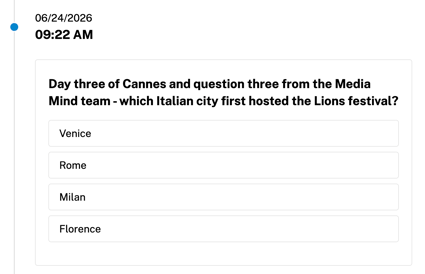 One of the quizzes featured in the 2026 live blog
📈 Sustained engagement throughout the event
Perhaps the most interesting finding wasn't just the increase in interactions - it was when they happened.
The 2025 live blog generated most of its engagement early in the event before gradually tapering off. In contrast, the 2026 edition maintained a steady stream of audience interactions across all five days of Cannes Lions.
Rather than peaking at the beginning, readers continued participating throughout the event - a strong indication that interactive features helped sustain attention over time.
A wider pattern across publishers
The Media Leader case study is just one of many examples.
At Newsrewired 2025, JournalismUK used Tickaroo to power live coverage that delivered an average engagement time of 8 minutes 50 seconds - significantly higher than traditional article formats.
Across publishers, the pattern is consistent. When live journalism is designed for interaction, audiences stay longer and engage more deeply.
Live coverage is no longer just a format - it’s a strategy
Live journalism is evolving.
It is no longer just about reporting what happens as it happens. It is about designing coverage that holds attention while the story unfolds - especially around live events, where audiences want to follow, participate, and experience moments in real time.
The strongest live formats today do more than inform. They involve.
When live journalism becomes interactive, structured, and collaborative, audiences don’t just follow the story - they stay with it.
And that’s what’s setting the new benchmark for live coverage.

.webp?width=300&name=New%20Partner%20banner%20(2).webp)